
What Is Dry Film Development?
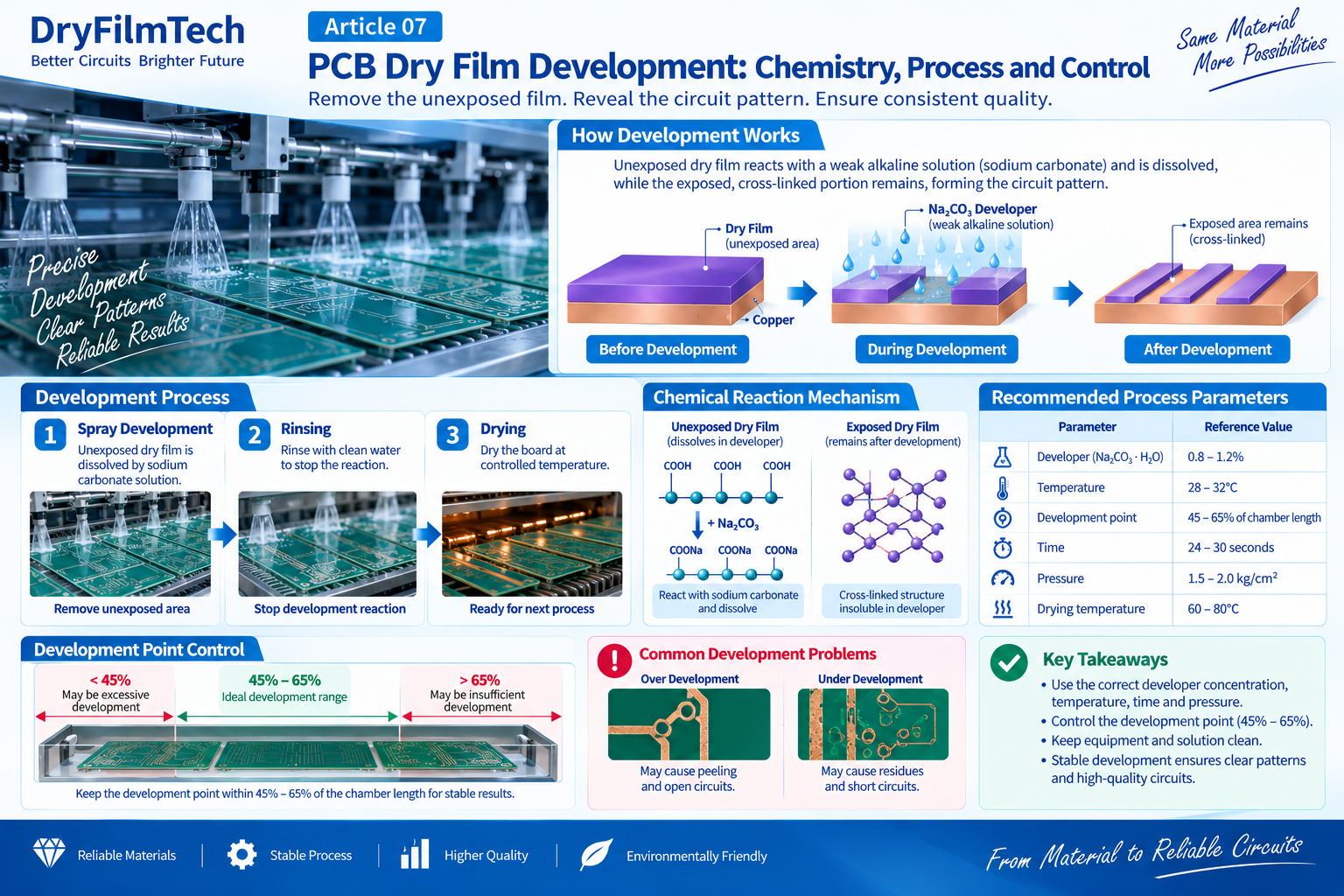
Development removes the unexposed portion of dry film while retaining the exposed, cross-linked portion, revealing the circuit pattern.
Development Mechanism
The unexposed portion contains active functional groups that react with a weak alkaline solution. The training material describes the reaction involving carboxyl groups and sodium carbonate. The exposed dry film has cross-linked and therefore remains during development.
Reference Parameters
- Developer: 0.8–1.2% Na₂CO₃·H₂O
- Temperature: 28–32°C
- Development point: 45–65% of developing chamber length
- Time: 24–30 seconds
- Pressure: 1.5–2.0 kg/cm²
- Drying temperature: 60–80°C
Development Point Control
- Below 45%: development may be excessive and can contribute to peeling and open circuits.
- Above 65%: development may be insufficient and can contribute to short circuits.
Conclusion
Stable development requires controlled chemistry and process parameters. The reference ranges are from the training material and should be verified for the specific dry film and equipment.